
Developer Survey Poll - Has Gen-AI Changed How You Learn and Get Help as a Developer?
A few days ago, I posted a quick survey to my network asking a question I’d been quietly sitting with for a while: has Gen-AI actually changed how we learn and get help as developers, or are we just doing the same things with a shinier tool?
11 responses came in (as of posting this), mostly from experienced engineers. It’s a small sample, so I’m not claiming statistical significance here. But the patterns that emerged were honest, and honestly, a little thought-provoking. I wanted to share what I found, along with my own take on each piece.
Who answered?
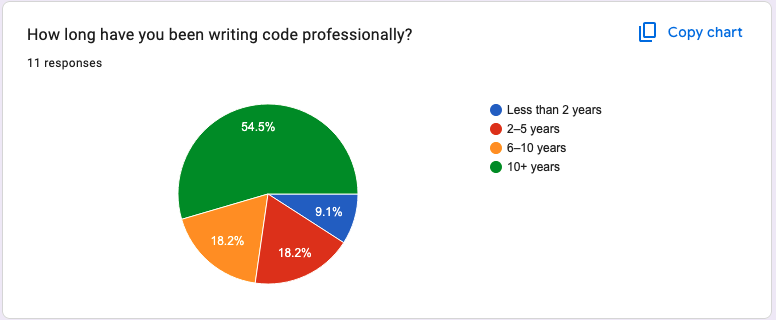
Most respondents were seasoned developers; the majority had 10 or more years of professional experience, with a handful in the 2–10 year range and one person just getting started. This skew matters for reading the results: we’re largely looking at a group that formed their learning habits before AI tools existed, and has since had to adapt (or choose not to).
How often are people actually using AI tools?
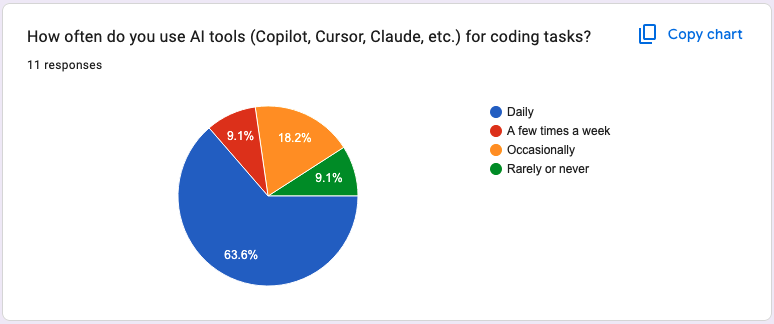
The majority of respondents use AI coding tools daily, with a smaller group reaching for them a few times a week or just occasionally. Only one person said they rarely or never use them.
This tells me adoption is pretty high among people who chose to answer a survey about this topic, which makes sense. What’s more interesting is what they do with those tools, and how it’s changed the rest of their workflow.
Has reliance on traditional resources actually shifted?
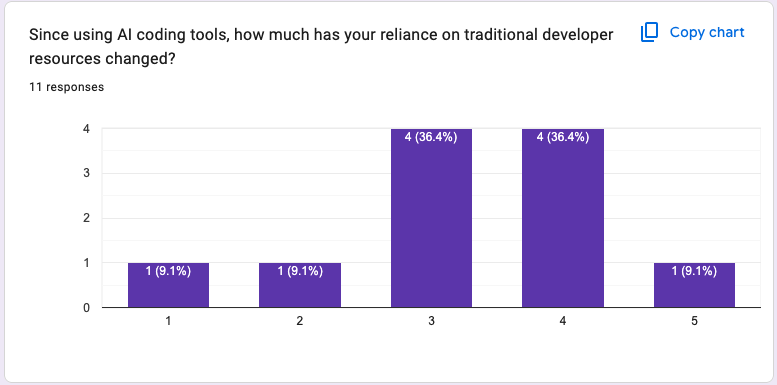
Respondents rated their shift on a scale of 1 to 5. The answers clustered heavily around 3 and 4, with a couple of people hitting 5. Only one person said 1, and they were also the person who rarely uses AI tools.
A shift of 3 or 4 out of 5 is substantial. That’s not “I sometimes check ChatGPT instead of Googling.” That’s a meaningful change in how people orient themselves when they hit a wall or need to learn something new.
What’s getting replaced?
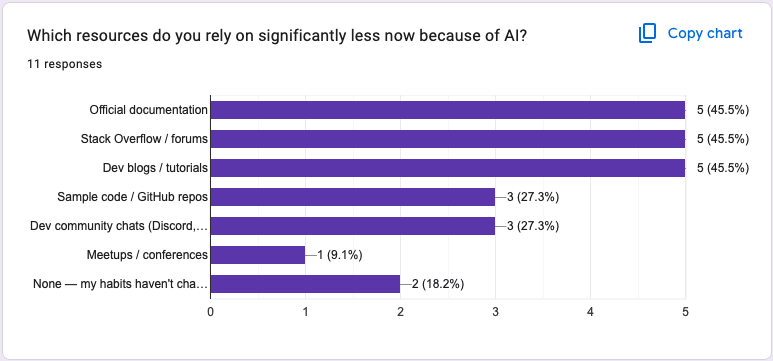
This one was telling. Official documentation, Stack Overflow, dev blogs, and sample code on GitHub were the most commonly cited casualties. Stack Overflow came up across multiple responses from developers with 6+ years of experience, which tracks with what we’ve been seeing in SO’s traffic numbers industry-wide.
Two respondents said their habits haven’t changed at all, both of whom use AI tools only occasionally or not at all. The correlation is clean: the more you use AI, the more it starts to absorb what used to be distributed across many sources.
How does each learning resource stack up week to week?
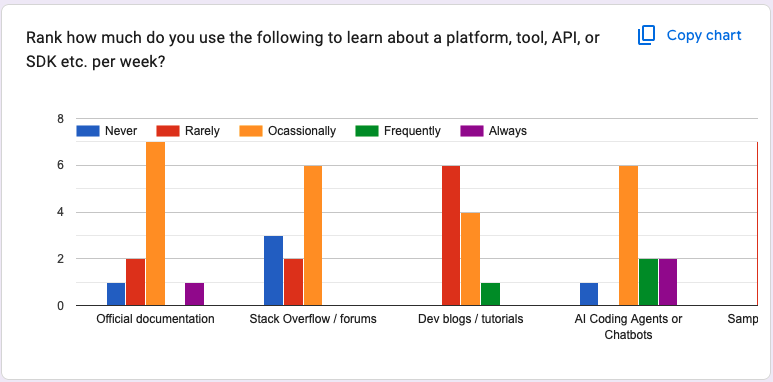
This section asked respondents to rate how frequently they use each resource weekly, from Never to Always.
Official Documentation
Documentation usage has settled into “occasionally” for most people, with a couple of respondents rarely touching it, and one person who still checks it always. It hasn’t disappeared, but it’s no longer the first stop it used to be.
Stack Overflow / Forums
Stack Overflow is fading fast. Most respondents land at rarely or never. Given how many of them explicitly named it as something they’ve deprioritized because of AI, this isn’t surprising. But it’s still a little melancholy if you’ve been in the community long enough to remember what SO meant to early-career devs.
Dev Blogs and Tutorials
Blogs are holding on, mostly at the “occasionally” level. They seem to serve a different purpose now, more for getting mental models and perspective than for copy-pasteable answers.
AI Coding Agents and Chatbots
This one is the obvious counterpart to everything declining above. AI tools sit at “frequently” or “always” for most daily users, and “occasionally” for the rest. It’s now clearly the dominant resource for week-to-week learning and problem-solving for most of the people in this group.
Sample Code / GitHub Repos
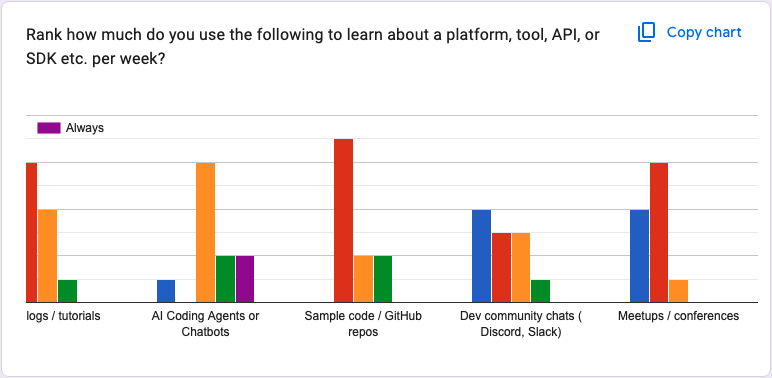
GitHub repos are still in the mix, though mostly at rarely to occasionally. One respondent uses them frequently. This makes sense; AI can explain how something works, but sometimes you just want to see a real project that’s already doing the thing.
Dev Community Chats (Discord, Slack)
Community chats have taken a hit. Most respondents are rarely or never in them for learning purposes. A couple of the more experienced folks still pop in occasionally. This one quietly stings a little, because community knowledge has a texture and nuance that AI isn’t great at replicating.
Meetups and Conferences
Mostly rarely or never, which isn’t new, honestly. Conferences were always a low-frequency resource for day-to-day learning. But the complete disappearance from the routine of several respondents is worth noting.
Where do people still prefer humans and traditional sources?
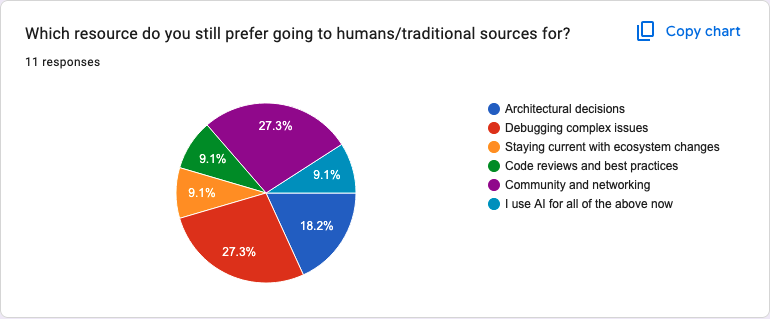
This question got the most varied answers, and I think it’s the most revealing.
Debugging complex issues, architectural decisions, and community/networking came up the most. Code reviews and best practices, staying current with ecosystem changes, and even “I use AI for all of the above now” rounded out the responses.
The thread running through the answers where humans still win is depth, judgment, and context. Architecture isn’t just a technical question; it’s a question about tradeoffs given your team, your constraints, your future plans. Code review is as much about culture and craft as it is about correctness. Community is irreplaceable for the ambient knowledge that never makes it into any documentation.
One respondent noted they use AI for everything now. That’s a valid choice, and I’m not here to judge it. But I do think it’s worth asking what we lose when there’s no human in the loop.
So, how does everyone feel about all this?
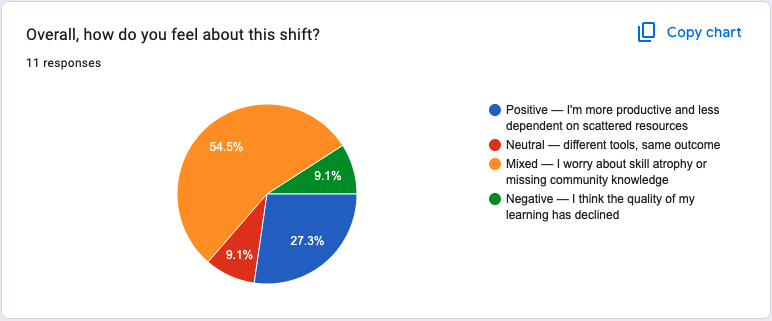
Here’s where it gets honest. The majority of respondents landed on “mixed,” with concerns about skill atrophy or missing out on community knowledge. Three people said positive. One person said negative, feeling that the quality of their learning has actually declined. Nobody chose “very negative.”
I find the “mixed” plurality really meaningful. These aren’t people who are anti-AI or unfamiliar with the tools. Most of them use AI daily. And yet, there’s a quiet unease sitting alongside the productivity gains. Something feels like it might be slipping.
My take
I’ll be honest: I relate to the “mixed” camp deeply.
AI tools have genuinely made me faster. I reach for them constantly. But I’ve also noticed that I can go days without reading a piece of writing from another developer, or sitting in a community space where someone’s struggling with the same thing I am, or just stumbling on a blog post that reframes how I think about a problem.
There’s a kind of learning that happens through friction and community that isn’t easily replicated by getting a clean answer in 3 seconds. The answer is useful. But the friction sometimes was too.
I don’t think the solution is to use AI less; that ship has sailed. But I do think it’s worth being intentional about keeping the other channels alive, not just as nostalgia, but because they develop different muscles.
Thanks to everyone who filled out the survey. It’s a small dataset, but it started a real conversation in my head, and I hope it does for you too.
If you want to share your own experience with how your learning habits have changed since using AI tools, I’d love to hear from you. Drop a comment or reach out directly.
Disclaimer
AI was used to generate illustrations/images (as noted), to fix typos, and/or improve the grammar of the written piece.