<?xml version="1.0" encoding="utf-8"?><feed xmlns="http://www.w3.org/2005/Atom" ><generator uri="https://jekyllrb.com/" version="4.4.1">Jekyll</generator><link href="https://www.amanaalam.com//feed.xml" rel="self" type="application/atom+xml" /><link href="https://www.amanaalam.com//" rel="alternate" type="text/html" /><updated>2026-04-15T02:18:42+00:00</updated><id>https://www.amanaalam.com//feed.xml</id><title type="html">Aman Aalam</title><subtitle>Pleasure to have you on my website. I am a Software Engineer and a Developer Advocate. I am based out of Hamilton, Canada.  I build Web Apps, REST APIs, and Mobile Apps.  I also speak publicly in tech conferences and events on topics related to programming, mobile tech, or related technologies</subtitle><entry><title type="html">Measuring DevRel Impact in the Changing Landscape — A Conversation with Mary Thengvall</title><link href="https://www.amanaalam.com//blog/measuring-devrel-impact-in-changing-landscape/" rel="alternate" type="text/html" title="Measuring DevRel Impact in the Changing Landscape — A Conversation with Mary Thengvall" /><published>2026-04-13T00:00:00+00:00</published><updated>2026-04-13T00:00:00+00:00</updated><id>https://www.amanaalam.com//blog/SCS_2875_127_%20Post%203_Interview1</id><content type="html" xml:base="https://www.amanaalam.com//blog/measuring-devrel-impact-in-changing-landscape/"><![CDATA[<div style="display: flex; gap: 2rem; align-items: flex-start; margin: 1.5rem 0;">
  <div style="flex: 1; min-width: 0;">

  <p>In this interview, I sat down with <a href="https://www.marythengvall.com/" target="_blank">Mary Thengvall</a> — author of <i><a href="https://www.persea-consulting.com/book" target-="_blank">The Business Value of Developer Relations</a></i>, founder of <a href="https://www.persea-consulting.com/" target-="_blank">Persea Consulting</a>, and former Head of Developer Relations at Camunda, and personally a mentor to me. We talked about what it means to measure DevRel impact when AI is quietly eating the top of the funnel.</p>

  <p>Mary's book was one of the first resources I turned to when I was finding my footing as a DevRel practitioner, and she's been just as generous in person, always willing to think through ideas together.</p>

  <p>You can find Mary on <a href="http://www.twitter.com/mary_grace" target="_blank">Twitter</a>, <a href="https://www.linkedin.com/in/marythengvall" target="_blank">LinkedIn</a>, and <a href="http://www.github.com/mary-grace" target="_blank">Github</a></p>

  </div>
  <div style="flex: 0 0 auto;">
    <img src="/assets/img/people/mary-thengvall.webp" alt="Mary Thengvall" style="width: 180px; border-radius: 8px; display: block;" />
  </div>
</div>

<hr />

<p>We discussed how measuring DevRel impact is changing (or remaining the same) as AI content generation tools evolve.</p>

<p>We explored it via five questions and some brutally honest answers.</p>

<h4 id="the-metrics-that-have-stayed-honest">The Metrics That Have Stayed Honest</h4>

<p><strong>Question 1. What metrics did you rely on two years ago to justify DevRel investment, and which of those do you still trust today?</strong><br />
<br />
Two years ago, Mary’s team at Camunda was running <a href="https://www.commonroom.io/">Common Room</a> across their entire community surface — forums, meetups, Reddit — piping identity resolution back into Salesforce to segment engagement by customers, prospects, and partners.</p>

<p>The goal was nuanced: were people engaging <em>more</em> after becoming customers, or going quiet once they had a CSM? That signal shaped how the team positioned community resources internally — as a deflection layer for support, or as a retention driver for existing customers.</p>

<p>That framework hasn’t fundamentally changed. <em>“I think AI presents another way for us to look at metrics, but it’s a question that’s always up in the air and something you need to keep track of,”</em> she said.</p>

<p>What has changed is where engagement happens. Forum traffic is down — but crawler traffic is up, which tells a different story. <em>“We’re not getting as many viewers on the website, but we are getting more information from crawlers, which says to me that people are still asking the questions — they just aren’t having to go direct to the forum.”</em></p>

<hr />

<h4 id="attribution-was-always-broken">Attribution Was Always Broken</h4>

<p><strong>Question 2: When a developer discovers and adopts your product through an AI-generated recommendation or code snippet, how do you attribute that? and does it even matter?</strong>
<br /></p>

<p>When a developer lands on your product after an AI-generated recommendation, does it matter how they got there?</p>

<p>Mary’s take is that attribution through AI or other intermediaries isn’t a new problem — it’s a louder version of the old one. <em>“Did they just use a different email address and we don’t know it, or did they see us at a conference and have an in-person conversation but weren’t ready for us to scan their badge?”</em></p>

<p><img src="/assets/img/broken-attribution.png" alt="representation of a bot reading a book" />
<small><small>Image generated using <a href="https://gemini.google.com/app?android-min-version=301356232&amp;ios-min-version=322.0&amp;is_sa=1&amp;hl=en-CA&amp;icid=microsite_gemini_image_generation_page" target="_blank">Google Nano Banana2 AI</a></small></small></p>

<p>The more useful reframe isn’t <em>how did they arrive</em> — it’s <em>what happens after they do</em>. That’s always been a DevRel responsibility, and AI actually raises the stakes: <em>“How do we improve the AI answers that people are seeing and receiving, and then also improve the experience that they have once they do interact with the website.”</em></p>

<p>Accurate, up-to-date documentation matters more now, not less. When AI is stitching together an onboarding path from your public content, stale docs become a product defect.</p>

<hr />

<h4 id="roi-pressure-has-gotten-real">ROI Pressure Has Gotten Real</h4>

<p><strong>Question 3: Has the pressure to prove DevRel ROI increased as AI has taken over more of the content work? How are you responding to that internally?</strong><br />
<br />
We’re seeing across the industry that DevRel teams are getting cut. Mary didn’t soften this - <em>“We’ve seen so many DevRel teams dissolved — really good, solid programs that have just gone away over the past couple of months. And I think a lot of it has to do with the perception that, well, it’s marketing and content and resources, and AI can write all of that itself.”</em></p>

<p>Her counterargument, though, is that the things that make DevRel effective aren’t the things AI replicates well. <em>“Developer advocates are always going to know what topics their community members are most interested in, what type of humor is going to resonate, what the in-jokes are.”</em></p>

<p>She’s not anti-AI — she uses it to draft outlines, sanity-check gaps, brainstorm. But she’s clear-eyed about where it breaks down: <em>“If it’s already that well-known of a topic, do you actually need to publish a blog post about it? Because everyone should already have that information.”</em> Original perspective, earned trust, community instinct — those still need a human.</p>

<hr />

<h4 id="leading-indicators-that-still-hold">Leading Indicators That Still Hold</h4>

<p><strong>Question 4: Are there leading indicators you’ve found that reliably predict developer adoption or retention, things that hold up even as the top-of-funnel gets noisier?</strong><br />
<br />
Predicting adoption is still hard. But our discussion kept coming back to network effects — specifically, the word-of-mouth layer that persists even as AI intermediates more discovery.</p>

<p>Mary says, <em>“There are still plenty of Slack communities that are completely volunteer-run where people go and say, ‘Hey, what tools do people use for X, Y, and Z?’ And those people are also asking AI — but they’re still relying on the people they know and trust and those firsthand testimonies.”</em></p>

<p>That’s where DevRel’s storytelling function has outsized leverage. You can’t manufacture a peer recommendation, but you can surface the ones that exist and make sure they’re heard at the right moment.</p>

<hr />

<h4 id="if-you-had-to-boil-it-down">If You Had to Boil It Down</h4>

<p><strong>Question 5: If you had to reduce DevRel to one or two outcomes that the rest of the business unambiguously cares about, what would they be?</strong><br />
<br />
Mary pushed back on the framing of universal DevRel outcomes — and she’s right to. <em>“The goals of the company often dictate the goals of the DevRel team, and I don’t think that’s a bad thing.”</em> A seed-stage company needs awareness and word-of-mouth reach. A 20-year-old company needs community depth and change management.</p>

<p>At Camunda, the anchor metrics were developer experience improvement (directly tied to retention) and engagement continuity through product transitions. The discipline was always the same: draw a straight line from team goal to company goal, then show contribution at review time.</p>

<p><em>“You can directly go back to your goals that you had for your team and say, ‘Here’s how we directly contributed to those goals’ — which hopefully helps with those conversations of, okay, but why is your team still important?”</em></p>

<p>As <a href="https://twitter.com/kelseyhightower">Kelsey Hightower</a> once put it: DevRel is what your employer pays you to do. Whoever funds the team defines the function. The job is to make sure that definition maps to something the business genuinely can’t live without.</p>

<hr />

<h6 id="disclaimer"><em>Disclaimer</em></h6>

<p><small>AI was used to generate illustrations/images (as noted), to fix typos, and/or improve the grammar of the written piece.</small></p>]]></content><author><name>Aman Aalam</name></author><category term="DevRel" /><category term="DevEx" /><category term="Interview" /><category term="SCS-2875-127" /><summary type="html"><![CDATA[I sat down with Mary Thengvall — Author, Founder, DevRel strategist, and former Head of Developer Relations at Camunda — to talk about what metrics still matter, how attribution works when AI is in the loop, and whether DevRel ROI pressure has intensified.]]></summary><media:thumbnail xmlns:media="http://search.yahoo.com/mrss/" url="https://www.amanaalam.com//assets/img/broken-attribution.png" /><media:content medium="image" url="https://www.amanaalam.com//assets/img/broken-attribution.png" xmlns:media="http://search.yahoo.com/mrss/" /></entry><entry><title type="html">Developer Survey Poll - Has Gen-AI Changed How You Learn and Get Help as a Developer?</title><link href="https://www.amanaalam.com//blog/gen-ai-developer-learning-survey/" rel="alternate" type="text/html" title="Developer Survey Poll - Has Gen-AI Changed How You Learn and Get Help as a Developer?" /><published>2026-04-10T00:00:00+00:00</published><updated>2026-04-10T00:00:00+00:00</updated><id>https://www.amanaalam.com//blog/SCS_2875_127_%20Post%205_PollResults</id><content type="html" xml:base="https://www.amanaalam.com//blog/gen-ai-developer-learning-survey/"><![CDATA[<p>A few days ago, I posted a quick survey to my network asking a question I’d been quietly sitting with for a while: has Gen-AI actually changed <em>how</em> we learn and get help as developers, or are we just doing the same things with a shinier tool?</p>

<p>11 responses came in (as of posting this), mostly from experienced engineers. It’s a small sample, so I’m not claiming statistical significance here. But the patterns that emerged were honest, and honestly, a little thought-provoking. I wanted to share what I found, along with my own take on each piece.</p>

<hr />

<h2 id="who-answered">Who answered?</h2>

<p><img src="/assets/img/polls/poll-question-1.png" alt="IMAGE: Q1 - How long have you been writing code professionally?" /></p>

<p>Most respondents were seasoned developers; the majority had 10 or more years of professional experience, with a handful in the 2–10 year range and one person just getting started. This skew matters for reading the results: we’re largely looking at a group that formed their learning habits <em>before</em> AI tools existed, and has since had to adapt (or choose not to).</p>

<hr />

<h2 id="how-often-are-people-actually-using-ai-tools">How often are people actually using AI tools?</h2>

<p><img src="/assets/img/polls/poll-question-2.png" alt="IMAGE: Q2 - How often do you use AI tools for coding tasks?" /></p>

<p>The majority of respondents use AI coding tools daily, with a smaller group reaching for them a few times a week or just occasionally. Only one person said they rarely or never use them.</p>

<p>This tells me adoption is pretty high among people who chose to answer a survey about this topic, which makes sense. What’s more interesting is what they do with those tools, and how it’s changed the rest of their workflow.</p>

<hr />

<h2 id="has-reliance-on-traditional-resources-actually-shifted">Has reliance on traditional resources actually shifted?</h2>

<p><img src="/assets/img/polls/poll-question-3.png" alt="IMAGE: Q3 - How much has your reliance on traditional developer resources changed? (1–5 scale)" /></p>

<p>Respondents rated their shift on a scale of 1 to 5. The answers clustered heavily around 3 and 4, with a couple of people hitting 5. Only one person said 1, and they were also the person who rarely uses AI tools.</p>

<p>A shift of 3 or 4 out of 5 is substantial. That’s not “I sometimes check ChatGPT instead of Googling.” That’s a meaningful change in how people orient themselves when they hit a wall or need to learn something new.</p>

<hr />

<h2 id="whats-getting-replaced">What’s getting replaced?</h2>

<p><img src="/assets/img/polls/poll-question-4.png" alt="IMAGE: Q4 - Which resources do you rely on significantly less now because of AI?" /></p>

<p>This one was telling. Official documentation, Stack Overflow, dev blogs, and sample code on GitHub were the most commonly cited casualties. Stack Overflow came up across multiple responses from developers with 6+ years of experience, which tracks with what we’ve been seeing in SO’s traffic numbers industry-wide.</p>

<p>Two respondents said their habits haven’t changed at all, both of whom use AI tools only occasionally or not at all. The correlation is clean: the more you use AI, the more it starts to absorb what used to be distributed across many sources.</p>

<hr />

<h2 id="how-does-each-learning-resource-stack-up-week-to-week">How does each learning resource stack up week to week?</h2>

<p><img src="/assets/img/polls/poll-question-5-1.png" alt="IMAGE - How does each learning resource stack up week to week" /></p>

<p>This section asked respondents to rate how frequently they use each resource weekly, from Never to Always.</p>

<h5 id="official-documentation">Official Documentation</h5>

<p>Documentation usage has settled into “occasionally” for most people, with a couple of respondents rarely touching it, and one person who still checks it always. It hasn’t disappeared, but it’s no longer the first stop it used to be.</p>

<h5 id="stack-overflow--forums">Stack Overflow / Forums</h5>

<p>Stack Overflow is fading fast. Most respondents land at rarely or never. Given how many of them explicitly named it as something they’ve deprioritized because of AI, this isn’t surprising. But it’s still a little melancholy if you’ve been in the community long enough to remember what SO meant to early-career devs.</p>

<h5 id="dev-blogs-and-tutorials">Dev Blogs and Tutorials</h5>

<p>Blogs are holding on, mostly at the “occasionally” level. They seem to serve a different purpose now, more for getting mental models and perspective than for copy-pasteable answers.</p>

<h5 id="ai-coding-agents-and-chatbots">AI Coding Agents and Chatbots</h5>

<p>This one is the obvious counterpart to everything declining above. AI tools sit at “frequently” or “always” for most daily users, and “occasionally” for the rest. It’s now clearly the dominant resource for week-to-week learning and problem-solving for most of the people in this group.</p>

<h5 id="sample-code--github-repos">Sample Code / GitHub Repos</h5>

<p><img src="/assets/img/polls/poll-question-5-2.png" alt="IMAGE: Q5e - Sample code / GitHub repos usage" /></p>

<p>GitHub repos are still in the mix, though mostly at rarely to occasionally. One respondent uses them frequently. This makes sense; AI can explain <em>how</em> something works, but sometimes you just want to see a real project that’s already doing the thing.</p>

<h5 id="dev-community-chats-discord-slack">Dev Community Chats (Discord, Slack)</h5>

<p>Community chats have taken a hit. Most respondents are rarely or never in them for learning purposes. A couple of the more experienced folks still pop in occasionally. This one quietly stings a little, because community knowledge has a texture and nuance that AI isn’t great at replicating.</p>

<h5 id="meetups-and-conferences">Meetups and Conferences</h5>

<p>Mostly rarely or never, which isn’t new, honestly. Conferences were always a low-frequency resource for day-to-day learning. But the complete disappearance from the routine of several respondents is worth noting.</p>

<hr />

<h2 id="where-do-people-still-prefer-humans-and-traditional-sources">Where do people still prefer humans and traditional sources?</h2>

<p><img src="/assets/img/polls/poll-question-6.png" alt="IMAGE: Q6 - Which resource do you still prefer going to humans/traditional sources for?" /></p>

<p>This question got the most varied answers, and I think it’s the most revealing.</p>

<p>Debugging complex issues, architectural decisions, and community/networking came up the most. Code reviews and best practices, staying current with ecosystem changes, and even “I use AI for all of the above now” rounded out the responses.</p>

<p>The thread running through the answers where humans still win is depth, judgment, and context. Architecture isn’t just a technical question; it’s a question about tradeoffs given your team, your constraints, your future plans. Code review is as much about culture and craft as it is about correctness. Community is irreplaceable for the ambient knowledge that never makes it into any documentation.</p>

<p>One respondent noted they use AI for everything now. That’s a valid choice, and I’m not here to judge it. But I do think it’s worth asking what we lose when there’s no human in the loop.</p>

<hr />

<h2 id="so-how-does-everyone-feel-about-all-this">So, how does everyone <em>feel</em> about all this?</h2>

<p><img src="/assets/img/polls/poll-question-7.png" alt="IMAGE: Q7 - Overall, how do you feel about this shift?" /></p>

<p>Here’s where it gets honest. The majority of respondents landed on “mixed,” with concerns about skill atrophy or missing out on community knowledge. Three people said positive. One person said negative, feeling that the quality of their learning has actually declined. Nobody chose “very negative.”</p>

<p>I find the “mixed” plurality really meaningful. These aren’t people who are anti-AI or unfamiliar with the tools. Most of them use AI daily. And yet, there’s a quiet unease sitting alongside the productivity gains. Something feels like it might be slipping.</p>

<hr />

<h2 id="my-take">My take</h2>

<p>I’ll be honest: I relate to the “mixed” camp deeply.</p>

<p>AI tools have genuinely made me faster. I reach for them constantly. But I’ve also noticed that I can go days without reading a piece of writing from another developer, or sitting in a community space where someone’s struggling with the same thing I am, or just stumbling on a blog post that reframes how I think about a problem.</p>

<p>There’s a kind of learning that happens through friction and community that isn’t easily replicated by getting a clean answer in 3 seconds. The answer is useful. But the friction sometimes was too.</p>

<p>I don’t think the solution is to use AI less; that ship has sailed. But I do think it’s worth being intentional about keeping the other channels alive, not just as nostalgia, but because they develop different muscles.</p>

<p>Thanks to everyone who filled out the survey. It’s a small dataset, but it started a real conversation in my head, and I hope it does for you too.</p>

<hr />

<p><em>If you want to share your own experience with how your learning habits have changed since using AI tools, I’d love to hear from you. Drop a comment or reach out directly.</em></p>

<h6 id="disclaimer"><em>Disclaimer</em></h6>

<p><small>AI was used to generate illustrations/images (as noted), to fix typos, and/or improve the grammar of the written piece.</small></p>]]></content><author><name>Aman Aalam</name></author><category term="DevRel" /><category term="Poll" /><category term="SCS-2875-127" /><summary type="html"><![CDATA[A small poll of 10 developers reveals how Gen-AI tools are quietly reshaping learning habits; with Stack Overflow fading, docs becoming a last resort, and a majority feeling mixed about where it's all heading]]></summary><media:thumbnail xmlns:media="http://search.yahoo.com/mrss/" url="https://www.amanaalam.com//assets/img/thumbnails/devsurvey.png" /><media:content medium="image" url="https://www.amanaalam.com//assets/img/thumbnails/devsurvey.png" xmlns:media="http://search.yahoo.com/mrss/" /></entry><entry><title type="html">EEAT Analysis - Community Pulse Podcast E103</title><link href="https://www.amanaalam.com//blog/eeat-analysis-community-pulse-podcast-e103/" rel="alternate" type="text/html" title="EEAT Analysis - Community Pulse Podcast E103" /><published>2026-04-02T00:00:00+00:00</published><updated>2026-04-02T00:00:00+00:00</updated><id>https://www.amanaalam.com//blog/SCS_2875_127_%20Post%202_EEAT%20Analysis</id><content type="html" xml:base="https://www.amanaalam.com//blog/eeat-analysis-community-pulse-podcast-e103/"><![CDATA[<p>This post presents an EEAT evaluation framework applied to a podcast episode.
I have structured it as a scored audit across four dimensions: expertise and experience, personality and individuality, trust and authority, and format and engagement. Each dimension is assessed with qualitative commentary and a numerical score, closing with a summary scorecard table. The goal is to give content creators a practical lens for evaluating whether their content meets the quality signals that matter for both human audiences and search/AI systems.</p>

<p><img src="/assets/img/eeat-analysis-podcast.png" alt="representation of a bot reading a book" />
<small><small>Image generated using <a href="https://gemini.google.com/app?android-min-version=301356232&amp;ios-min-version=322.0&amp;is_sa=1&amp;hl=en-CA&amp;icid=microsite_gemini_image_generation_page" target="_blank">Google Nano Banana2 AI</a></small></small></p>

<h3 id="1-expertise--experience-does-it-go-beyond-what-ai-could-say">1. Expertise &amp; Experience: Does It Go Beyond What AI Could Say?</h3>

<p>This is where the episode shines brightest, and it’s almost ironic given the topic.</p>

<p>The hosts aren’t theorizing about AI content ethics from the outside. They’re living inside it.
Jason works at Datadog and describes running an internal advocacy hackathon specifically to
stress-test AI tools in production workflows. Wesley shares a raw, firsthand account of trying
to generate promo content in Google’s VO, only to have the AI erase him and replace him. PJ grounds the entire conversation in the lived reality of watching AWS fire
16,000 people, many of whom he personally knew in the developer community.</p>

<p>That last detail matters. It’s the kind of specific, human texture that no AI would volunteer.
It names the collateral damage: not just the people who lost jobs, but the communities they
served, who are now quietly devalued too.</p>

<p><strong>Where it could go deeper:</strong> The episode stops short of giving the audience actionable
takeaways. What should a Dev Rel practitioner actually <em>do</em> differently when creating content
in this environment? That gap is where the unique expertise doesn’t fully land; the insights
are real, but they’re not yet translated into something the listener can apply.</p>

<p><strong>Score: 7/10,</strong> rich lived experience, but the practical “so what” is left on the table.</p>

<hr />

<h3 id="2-personality--individuality-does-the-brand-come-through">2. Personality &amp; Individuality: Does the Brand Come Through?</h3>

<p>Unmistakably, yes. This is a four-person podcast that clearly has a long history of talking
together, and it sounds like it. The disagreements are genuine: PJ is the skeptic, Jason is
the cautious optimist, Wesley is the one dropping cultural references (shoutout to
<em>The Twilight Zone: It’s a Good Life</em>) and real-world receipts. Nobody is performing a take
for the algorithm.</p>

<p>The moment PJ says <em>“evil pays money”</em> in response to Jason’s optimism about Google
self-correcting, that’s a personality. That’s a worldview. You can’t easily prompt-engineer that
out of an AI.</p>

<p><strong>Score: 6.5/10,</strong> strong individual voices, weaker brand identity and show positioning.</p>

<hr />

<iframe data-testid="embed-iframe" style="border-radius:12px" src="https://open.spotify.com/embed/episode/1Ell5ruBhzsTJuIjTQum57?utm_source=generator" width="100%" height="352" frameborder="0" allowfullscreen="" allow="autoplay; clipboard-write; encrypted-media; fullscreen; picture-in-picture" loading="lazy"></iframe>

<h3 id="3-trust--authority-research-citations-expert-backing">3. Trust &amp; Authority: Research, Citations, Expert Backing</h3>

<p>This is the episode’s weakest dimension, and they actually <em>talk about this very problem</em>
in the episode itself, which makes it a little painful.</p>

<p>PJ explicitly calls out an AI-generated piece of content that had no attribution, no
references, and incorrect or misleading information. And yet, the episode itself cites the
Stack Overflow Developer Survey by feel rather than by fact (“developers are saying they
don’t use code agents 70% of the time”; paraphrased, not sourced). The Block and AWS layoffs
are mentioned as known facts without links. The AEO/GEO terminology is introduced without
context for listeners who haven’t encountered it.</p>

<p>That’s not fatal for a casual podcast conversation. But if this content is going to be
repurposed into a blog post, LinkedIn article, or referenced piece, it needs a layer of
citations underneath it to avoid being exactly the kind of unattributed content they’re
critiquing.</p>

<p>There’s authority in the room, Jason at Datadog, Wesley with hands-on production experience,
but that authority isn’t <em>established</em> for a new listener. It’s assumed.</p>

<p><strong>Score: 5/10,</strong> the credibility is there implicitly, but it’s not packaged in a way that
builds trust for a new audience.</p>

<hr />

<h3 id="4-format--engagement-how-well-does-it-hold-attention">4. Format &amp; Engagement: How Well Does It Hold Attention?</h3>

<p>Evaluated as a <em>podcast</em>, the format works reasonably well. The conversation has natural
energy and the hosts interrupt each other in a way that feels like a real debate rather than
a scripted panel.</p>

<p>But if this transcript were turned into written content (a fair question for E-E-A-T
purposes), it would need significant restructuring. The transcript as-is has:</p>

<ul>
  <li><strong>No clear sections or signposting;</strong> the conversation jumps from Block layoffs to AEO/GEO
to the Stack Overflow survey to hackathon demos to Sora replacing Wesley to hallucination
failures, with no connective tissue.</li>
  <li><strong>No pull quotes or highlighted moments;</strong> there are genuinely quotable lines here
(“evil pays money,” “agents writing for agents”) that would work brilliantly as callouts.</li>
  <li><strong>No multimedia hooks;</strong> for a podcast that <em>discusses</em> AI-generated video and image tools
firsthand, there’s an obvious opportunity to embed clips or visuals.</li>
  <li><strong>Poor mobile readability if transcribed as-is;</strong> large dense blocks of speech don’t
translate to scannable paragraphs.</li>
</ul>

<p><strong>Score: 5.5/10,</strong> great raw material, but needs editorial shaping before it works as
written content.</p>

<hr />

<h3 id="overall-e-e-a-t-scorecard">Overall E-E-A-T Scorecard</h3>

<table>
  <thead>
    <tr>
      <th>Dimension</th>
      <th>Score</th>
    </tr>
  </thead>
  <tbody>
    <tr>
      <td>Expertise &amp; Experience</td>
      <td>7/10</td>
    </tr>
    <tr>
      <td>Personality &amp; Individuality</td>
      <td>6.5/10</td>
    </tr>
    <tr>
      <td>Trust &amp; Authority</td>
      <td>5/10</td>
    </tr>
    <tr>
      <td>Format &amp; Engagement</td>
      <td>5.5/10</td>
    </tr>
    <tr>
      <td><strong>Overall</strong></td>
      <td><strong>6/10</strong></td>
    </tr>
  </tbody>
</table>

<p>The core ingredients for a high-E-E-A-T piece are genuinely here: real people, real
experiences, real disagreement. What it needs is an editorial pass that surfaces the insights
more deliberately, adds the citations it critiques others for lacking, and structures the
content for a reader (not just a listener) who’s coming in cold and needs a reason to trust
the voices in the room.</p>

<h6 id="disclaimer"><em>Disclaimer</em></h6>

<p><small>AI was used to generate illustrations/images (as noted), to fix typos, and/or improve the grammar of the written piece.</small></p>]]></content><author><name>Aman Aalam</name></author><category term="DevRel" /><category term="EEAT Analysis" /><category term="SCS-2875-127" /><summary type="html"><![CDATA[A practical EEAT audit of a podcast episode on AI content ethics; evaluating how well it demonstrates real expertise, builds trust with its audience, and holds up as content worth ranking. Scored across four dimensions: expertise and experience, personality and individuality, authority and citations, and format and engagement.]]></summary><media:thumbnail xmlns:media="http://search.yahoo.com/mrss/" url="https://www.amanaalam.com//assets/img/eeat-analysis-podcast.png" /><media:content medium="image" url="https://www.amanaalam.com//assets/img/eeat-analysis-podcast.png" xmlns:media="http://search.yahoo.com/mrss/" /></entry><entry><title type="html">The Angry Customer</title><link href="https://www.amanaalam.com//blog/the-angry-customer/" rel="alternate" type="text/html" title="The Angry Customer" /><published>2026-02-23T00:00:00+00:00</published><updated>2026-02-23T00:00:00+00:00</updated><id>https://www.amanaalam.com//blog/SCS_2875_127_%20Post%201_%20The%20Angry%20Customer</id><content type="html" xml:base="https://www.amanaalam.com//blog/the-angry-customer/"><![CDATA[<p><img src="/assets/img/the-angry-customer.png" alt="The Angry Customer" />
<small><small>Image generated using <a href="https://gemini.google.com/app?android-min-version=301356232&amp;ios-min-version=322.0&amp;is_sa=1&amp;hl=en-CA&amp;icid=microsite_gemini_image_generation_page" target="_blank">Google Nano Banana2 AI</a></small></small></p>

<p>It’s the day of your talk at a local meetup, you have prepared for this tech-talk for over two weeks, and it talks about all the good things your product can do for developers. It takes an hour to reach the venue. You deliver your talk with presentation and live code demo, which is well received overall, and you get off the stage. In the networking session when you’re getting ready to pack and leave, an attendee comes forward, introduces themselves. They confirm if you’re from “<em>that”</em> company, immediately launching a tirade against how some policy, a bug, or a discontinued product feature has completely destroyed their business.</p>

<p>The more they describe their loss, the more they’re reminded of the pain, causing the tones and tension to flare up.</p>

<p>Congratulations, you have encountered The Angry Customer.</p>

<p>This is a customer who trusted your product, perhaps even paid for it, but didn’t get the support or experience they were expecting, and they are livid.</p>

<p>You can find them in-person, or online - in forums, chat rooms, or in emails.</p>

<p>How do you handle that? Let’s explore.</p>

<h2 id="why-it-happens">Why it happens</h2>

<p>Before addressing the tactics to handle the situation, let’s spend a little time understanding why this happens. Because once you’re able to empathize with the situation, you can come up with your own creative solutions.</p>

<p>While it’s totally possible that the customer misunderstood the offering, the commitment, and the product; Or that they didn’t read a documentation they were supposed to read well - but it’s also possible that your employer is totally at fault.</p>

<p>Still, more often than not, it highlights a few factors that are more inward than outward:</p>

<ul>
  <li><strong>Broken support paths, or unresponsive support systems</strong><br />
The human tendency found in most software programmers is to help themselves get out of a situation that’s impeding their progress. So they will <a href="https://whatfix.com/blog/customer-self-service/">try on their own</a>, as much as possible, to find solutions to the issues they are facing.<br />
They’ll Google or GPT for a solution, try to look for existing issues in your issue trackers, or forums, try to reach out to your support team etc.<br />
Maybe you don’t have public forums or issue trackers addressing myriads of issues others face, or your <a href="https://gradient-labs.ai/blog/press-1-for-support-2-for-frustration">support takes too long</a> to respond and uses canned responses when they respond.<br />
The anger rises only when the customer repeatedly fails to resolve their issues by all available means, and there’s nothing further they can do while their product and their users’ experience deteriorates.</li>
</ul>

<p>As an example, try to reach out to GMail or Facebook for support, and see how it goes. Before you say you don’t pay for GMail, the paid customers of Google One have a similar experience - I know because I am one.</p>

<ul>
  <li>
    <p><strong>Broken docs or inadequate communication</strong><br />
The documentation that is supposed to help the customer isn’t <a href="https://www.fluidtopics.com/blog/customer-support/7-self-service-best-practices-to-improve-customer-support/">incomplete</a>, outdated, broken, or just doesn’t address this customer’s concerns at all. Sometimes you find that the issue wasn’t technical at all but was related to how the customer’s account was set up, which plan they’re on etc.<br />
Your product’s error message likely failed to communicate the issue better and the customer hit the roadblock.</p>
  </li>
  <li>
    <p><strong>Lost in the numbers</strong><br />
Some internal decisions, failed to account for the edge-case customers, and that customer was <a href="https://ozmo.com/blog/customer-rage-survey-2023/">just another customer</a> in the sea of affected user, considered collateral damage by your employer. This interaction is just putting a face to a person who was just a random number in a sheet inside your company so far.<br />
This also shows the lack of communication, along with lack of options that your employer couldn’t provide. Maybe there was no other way either.</p>
  </li>
  <li>
    <p><strong>Sense of loss</strong><br />
After spending months to integrate your product, if a customer finds that their ability to do business is being hampered by your product, they get grappled by a sense of loss and a sense of lack of control. This culminates, many times, to anger, resulting in such interactions via different channels.</p>
  </li>
</ul>

<h2 id="addressing-the-situation">Addressing the Situation</h2>

<p><img src="/assets/img/calm-in-the-storm.png" alt="Calm in the Storm" />
<small><small>AI-Generated image, generated by <a href="https://chatgpt.com/">ChatGPT</a></small></small></p>

<p>I have been a DevRel practitioner for about 11 years now, and I still meet ~100 people every month in meetups that I host. In my personal experience, the best approaches almost always require non-technical skills to be employed first. Here’s what has helped me a great deal in situations like these, maybe it helps you too or gives you some ideas:</p>

<ul>
  <li>
    <p><strong>Stay Calm</strong>: staying calm helps access the logical side of your brain, so you can think and respond, instead of reacting to the situation.</p>
  </li>
  <li>
    <p><strong>It’s not Personal</strong>: It’s very important to understand that the customer is not mad at you personally, you just happen to be the only person from your company that they could find to talk to. They’re mad at the situation, not a person. It’s best not to be defensive in such situations.</p>
  </li>
  <li>
    <p><strong>Agree with the grievance, and then try to understand it</strong>: They say, ‘the first step to solve a problem is recognizing there’s one’. Once you have realized that the situation is not personal, and you have found a way to stay calm, now you can tackle this. 
Agreeing with the customer - that the grievance exists, that you can understand why they must be feeling bad, and that the situation is indeed bad - will help the customer cool down.<br />
Take an apologetic, humble tone and demeanour if needed.<br />
Let them explain and vent out their grievances.<br />
When you find a chance, try to understand, in detail, what happened, try to recognize where things might have gone wrong, and think if there’s something you can do.<br />
This helps disarms the person interacting with you and should hopefully put them in a state where you can work with them to resolve the situation.<br />
You may not be able to help right there and then, and a calmed down customer will recognize that. Their problem, mostly likely, wasn’t that there wasn’t a solution, but that there was no communication or education on how to handle it. So you can definitely take the conversation over email or other channels, assuring the customer that you will address it internally and get it sorted.</p>
  </li>
</ul>

<p>Sometimes you will never have a solution, in those cases, a simple “I am sorry, I tried my best” goes a long way.</p>

<ul>
  <li><strong>View it as an Opportunity</strong>:  It is a good chance to take this as a learning opportunity, to understand if there’s something you can do - Developer Communication or Developer Education wise - which can help others from falling into similar situations. Many times, you’ll see that this is a cross-functional learning. These are also rare instances to find out what your teams are ignoring or what is in their blind spot.</li>
</ul>

<h2 id="winning-back-the-loyalty">Winning back the Loyalty</h2>

<p>Customers or user who had a really-bad experience, are the best candidates to be wowed and earn good relations with. After all, you helped them get out of a sticky situation. And if you handled it right, not only do you win that customer for life and set them up for success, you’ll also turn them into an advocate for your products and services.</p>

<p>They’ll tell their peers about how you and your company did take their issues into account, solved them, and promised to implement improvements. They’ll also likely use your product again and again, even if they’re in new roles further in their life.</p>

<p>It will take time, it may not be easy, but In my experience, these are the customers who later become your strongest advocates.</p>

<p>And the angry customer at the meetup? It happened to me in real life.</p>

<p>The issue was a result of a limit my employer had introduced, and I couldn’t resolve it.</p>

<p>But The Angry Customer continues to show up in all the channels of developer support and communication, and the tips shared here continue to help me.</p>

<h6 id="disclaimer"><em>Disclaimer</em></h6>

<p><small>AI was used to generate illustrations/images (as noted), to fix typos, and/or improve the grammar of the written piece.</small></p>]]></content><author><name>Aman Aalam</name></author><category term="DevRel" /><category term="HowTo" /><category term="Opinion" /><category term="SCS-2875-127" /><summary type="html"><![CDATA[Two weeks of prep, a talk that lands — then someone corners you at the networking session with a story of how your product failed them. Meet The Angry Customer. How you handle this moment matters. Let's explore.]]></summary><media:thumbnail xmlns:media="http://search.yahoo.com/mrss/" url="https://www.amanaalam.com//assets/img/the-angry-customer.png" /><media:content medium="image" url="https://www.amanaalam.com//assets/img/the-angry-customer.png" xmlns:media="http://search.yahoo.com/mrss/" /></entry><entry><title type="html">From stage-shy to WorldTours</title><link href="https://www.amanaalam.com//blog/from-stage-shy-to-worldtours/" rel="alternate" type="text/html" title="From stage-shy to WorldTours" /><published>2020-07-16T18:46:45+00:00</published><updated>2020-07-16T18:46:45+00:00</updated><id>https://www.amanaalam.com//blog/from-stage-shy-to-worldtours</id><content type="html" xml:base="https://www.amanaalam.com//blog/from-stage-shy-to-worldtours/"><![CDATA[<p>I spoke at DevRelCon 2020 about how I dealth with my fear of the camera, the stage fright, and started public speaking.</p>

<p>Here are the Google Slides from the talk-</p>

<iframe src="https://docs.google.com/presentation/d/e/2PACX-1vR6ZDPLp_BxGPUFdgqGWHgQSSvUW8R-43DlY0dh7raQJZLFkHzBbsNgOKZ9l1pTCITWVgTB-Mr0YGjt/embed?start=false&amp;loop=false&amp;delayms=3000" frameborder="0" width="960" height="569" allowfullscreen="true" mozallowfullscreen="true" webkitallowfullscreen="true"></iframe>]]></content><author><name>Aman Aalam</name></author><category term="DevRel" /><category term="Public Presentations" /><category term="Talks" /><summary type="html"><![CDATA[Slides from the talk at DevRelCon 2020]]></summary></entry><entry><title type="html">Who and what is a Developer Advocate</title><link href="https://www.amanaalam.com//blog/who-is-a-developer-advocate/" rel="alternate" type="text/html" title="Who and what is a Developer Advocate" /><published>2020-04-12T01:45:17+00:00</published><updated>2020-04-12T01:45:17+00:00</updated><id>https://www.amanaalam.com//blog/who-is-a-developer-advocate</id><content type="html" xml:base="https://www.amanaalam.com//blog/who-is-a-developer-advocate/"><![CDATA[<p>I was fortunate to have worked with, and nurture developer communities. During my days of community organizing and public speaking, I was regularly interacting with developer advocates from different companies, primarily Google. At that time I never thought much about what the title meant, or what the job entailed. It was just about trying to deliver value to the community I was representing, whoever I interacted with from those companies, being an efficient bridge between the two.</p>

<p>In this post, I’ll try to explain what is a developer advocate, and what we do in developer advocacy.</p>

<h3 id="background"><strong>Background</strong></h3>

<p>A few years into my initial years as a community speaker, when I became a developer advocate myself, I began realizing that explaining what I do, is not as straightforward for people, as it is for people coming from a community organizing background.</p>

<p>Part of the problem, I believe, are the two <em>key</em> words (developer and advocate) used to describe this profession and discipline, which are generally not associated together.</p>

<p>The funniest instances were when people thought I worked in the legal department, looking at the word “advocate” in my job title, and asked me if I am an advocate for software developers when they get into legal troubles 🤷🏻‍♂️.</p>

<p>It occurred to me that in some parts of the world, Lawyers are synonyms to  Advocates, so it’s natural for people to assume so.</p>

<blockquote class="wp-block-quote has-text-align-right is-style-large">
  <p>
    Almost all the technical documentation, code samples, educating videos from software companies that you see, are perhaps written or prepared by a Developer Advocate
  </p>
</blockquote>

<h3 id="so-are-we-lawyers-what-do-we-do"><strong>So are we lawyers? What do we do?</strong></h3>

<p>Without any hard feelings for lawyers – thankfully, we’re not 😃 .</p>

<p>The word advocacy implies you’re arguing in favour of a person, group, or cause.</p>

<figure>
  <img src="https://www.amanaalam.com//assets/img/wp-content/uploads/2020/04/devadvocate-dictionary-definition.png" alt="Image: dictionary definition of the word advocacy" />
  <figcaption>Image: dictionary definition of the word advocacy</figcaption>
</figure>

<p>Anybody who does any kind of advocacy, is an advocate for that person, group or cause.</p>

<p>That way, Lawyers in fact do advocacy for their clients, and so they’re advocates of their clients.</p>

<p>Similarly a developer advocate argues in favour of, and represents, a developer community. A Developer Advocate is advocating in favour of developers, thus the name - Developer Advocate.</p>

<p><strong>Lawyers</strong> = Advocating for their clients<br />
<strong>Developer Advocates</strong> = Advocating for software developers and engineers</p>

<p>We make sure developers have a voice within our teams, and they have an engaging experience with the software products which we’re representing.</p>

<h3 id="who-are-the-developers-we-advocate-for"><strong>Who are the developers we advocate for</strong></h3>

<p>It depends on which capacity we’re working in, and who’s the target audience. In all the cases, you’re advocating for the software developers who are either working in the same organization, or are creating software with the products (<a href="https://en.wikipedia.org/wiki/Application_programming_interface">APIs</a>, <a href="https://en.wikipedia.org/wiki/Software_development_kit">SDKs</a> etc.) that your organization builds.</p>

<p>Generally a Developer Advocate would be working for a Software company/organization. Then depending on the organizational needs, you can either be an advocate for internal or external developers.</p>

<p>I like to call internal developers as 1st Party developers; developers of the paying customers/partners of my employer as 2nd Party developers; and everybody else as 3rd Party developers.</p>

<p>Together, these developers form a community of developers who you’re trying to help. But more on developer communities later.</p>

<p>For example, if you’re working in the Android Developer Relations team at Google, the Play Store app engineering team could be called as 1st party developers, Google Partner app developers, OEM manufacturers etc., as 2nd party developers, and all other non-partner Android app developers as 3rd party developers.<br />
(Of course, this is just an example and may not exactly be how Google <em>refers to these people internally)</em>.</p>

<h3 id="how-do-we-typically-do-this">How do we typically do this</h3>

<p>As Developer Advocates, or, as a part of a Developer Relations team, we try to touch base with developers on multiple points. We try to provide as much value as possible to these developers, and make them successful in whatever they’re trying to achieve.</p>

<p>We add value by making documentation easier and more useful, writing case studies, blogs, how-to guides, conducting workshops, webinars, or anything that can help our developer community become successful and more effective.</p>

<figure>
  <img src="https://www.amanaalam.com//assets/img/wp-content/uploads/2020/04/AmanAtGTUGDelhi-1024x682.jpg" alt="Image: at GTUG Delhi DevFest | c. 2012" sizes="(max-width: 1024px) 100vw, 1024px" />
  <figcaption>_Image: at GTUG Delhi DevFest | c. 2012_</figcaption>
</figure>

<p>As a passionate Developer Advocate, you’ll easily find yourself speaking very often at local tech meetups, about topics either directly related to the software products you advocate for, or about general tech stuff.</p>

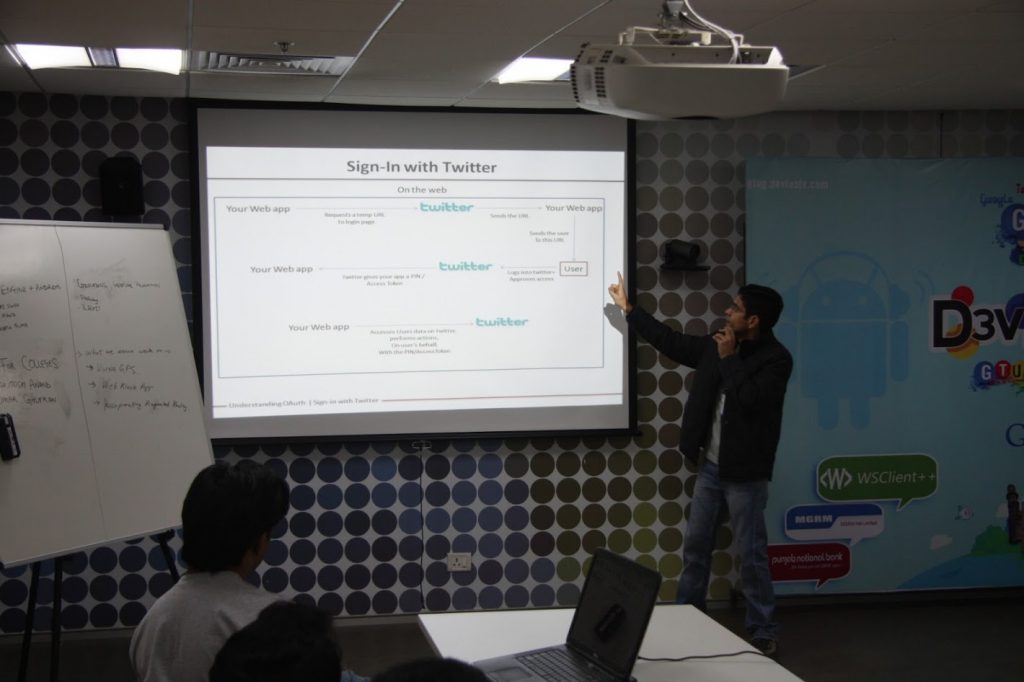
<p>In the photo above, that’s me trying to explain how Twitter SSO works using OAuth, in 2012.</p>

<figure>
  <img src="https://www.amanaalam.com//assets/img/wp-content/uploads/2020/04/AionAtJAX-843x1024.jpeg" alt="Image: at JAX London | c. 2019" sizes="(max-width: 1024px) 100vw, 1024px" />
  <figcaption>_Image: at JAX London | c. 2019_</figcaption>
</figure>

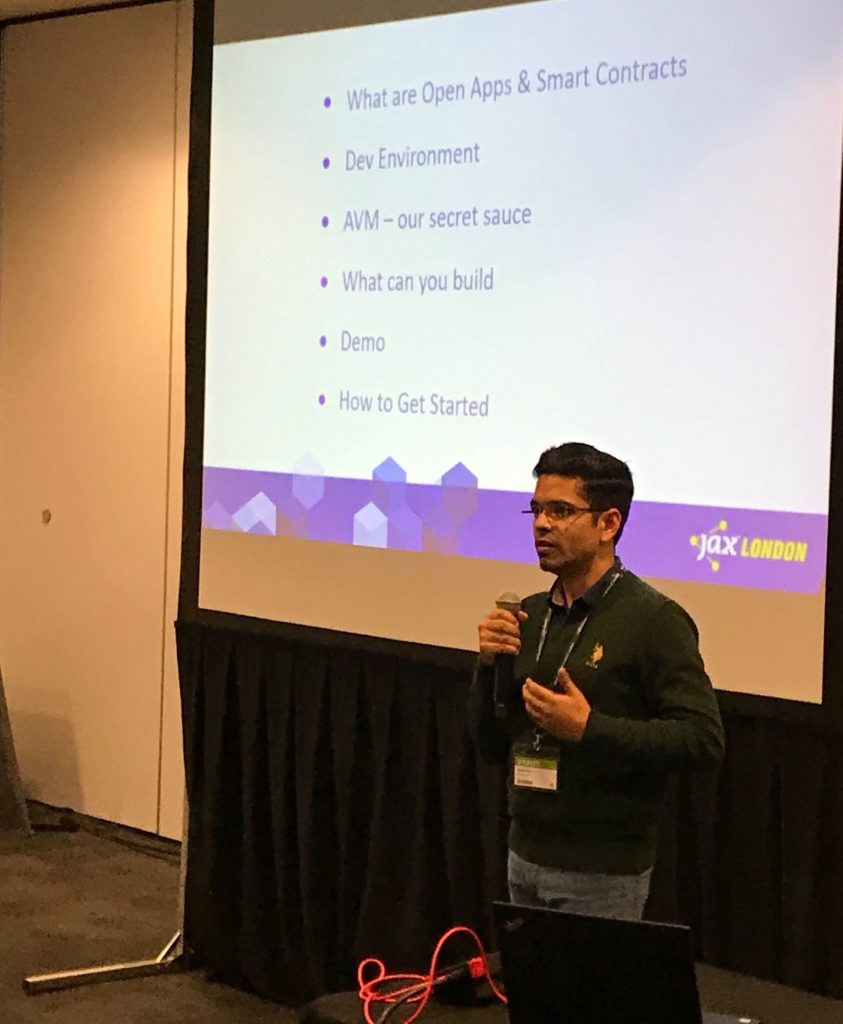
<p>We go wherever the developers are, and tell them about what we have to offer. It often takes us to different events like conferences, panel discussions, meetups etc., which are sometimes held in very interesting cities and places.</p>

<p>As a part of your charter to make developers successful, you often make or work with online and offline communities of the developers you target. I’ll talk about communities in a separate post.</p>

<h3 id="developer-advocates-vs-developer-evangelists">Developer Advocates vs Developer Evangelists</h3>

<p>These titles are often synonyms in practical sense, because essentially you’re doing the same thing whether you’re an Advocate or an Evangelist.</p>

<p><u>Evangelist</u>, in literal terms, is supposed to only talk to outside developers with a goal to evangelize and popularize a software product.</p>

<p><u>Advocates</u>, on the other hand, are supposed to be the bridge between the organization and the software developers outside of the organization.</p>

<p>Developer Advocacy is thus a two-way street. On one hand you take your software product to outside developers, and advocate for this product to these developers. At the same time, you’re also supposed to listen to the pains or experiences of these developers, take the feedback - positive and negative - from them, and advocate for these developers before the product, engineering or other appropriate teams.</p>

<h3 id="why-cant-marketers-to-developer-advocacy">Why can’t marketers to Developer Advocacy?</h3>

<p>That’s a valid question, and in fact at a lot of places that is what happens. But there are some nuances that set marketers and Developer Advocates apart.</p>

<p>If you need to engage and interact with an audience which is very technical, on platforms which are specifically their turf (tech conferences, meet-ups, developer documentation etc.), you have to choose professionals which can speak a technical language. Traditional marketers will face a lot of challenges preparing a very technical (and hence, engaging) content and narrative for this audience, because traditional marketers are not trained for this, it’s not their forte.</p>

<p>Moreover, you need to be very good at empathizing with this audience and answer their questions. Every missed opportunity here makes you lose more ground in the hearts and minds of developers.</p>

<p>Thus, Developer Advocates, which know the pains of other developers, know how to answer questions and touch the right chords, are the perfect people for this job.</p>

<h3 id="how-developer-advocacy-looks-from-within-an-organization">How Developer Advocacy looks from within an organization</h3>

<p>Many organizations have a dedicated team called Developer Relations. Since what we do tends to look a lot like marketing, but to Software Developers, some companies like to call it Developer Marketing too.</p>

<p>Other organizations sometimes have independent Developer Advocates working for similar goals.</p>

<p>In all capacities, the work of a Developer Advocate is HIGHLY cross functional and multi disciplinary you work with various teams to get your job done. I’ll talk about this more in another post.</p>

<p>In some organizations, the functions of Developer Advocacy are a part of CTO organization, in some places it’s under Business Development, and it’s under Marketing at other places.</p>

<p>Whatever the org structure may look like, we work heavily with internal teams - product, sales, engineering, marketing, and sometimes legal too (yes!) - and then talk to developers to make their experience with the products we represent, better.</p>

<hr />

<p>Hopefully you’re more aware of what we do the next time you get to meet a Developer Advocate. Come say hello - we are a friendly bunch! 🙂</p>]]></content><author><name>Aman Aalam</name></author><category term="DevRel" /><category term="How To" /><category term="DevRel" /><summary type="html"><![CDATA[If you have ever come across someone who says they're a Developer Advocate, or a Developer Evangelist, and you were curious what that is, this post is your explainer]]></summary></entry><entry><title type="html">I lived through Internet Shutdown in Lucknow, and it wasn’t cool</title><link href="https://www.amanaalam.com//blog/living-through-internet-shutdown/" rel="alternate" type="text/html" title="I lived through Internet Shutdown in Lucknow, and it wasn’t cool" /><published>2020-03-11T20:35:35+00:00</published><updated>2020-03-11T20:35:35+00:00</updated><id>https://www.amanaalam.com//blog/lived-through-internet-shutdown</id><content type="html" xml:base="https://www.amanaalam.com//blog/living-through-internet-shutdown/"><![CDATA[<p>I traveled to my hometown of Lucknow, reaching there on December 17, 2019.<br />
Shortly after this day, anti CAA protests started all across the country, including in Lucknow. For some reasons, the UP government thought that Internet and SMS services should be shut down, perhaps to avoid spread of rumors, so on December 19 or so, the Mobile Data and SMS services were shut down, indefinitely.</p>

<p>Wired Broadband services continued to work, so anybody who had a wifi at home or office, or institutions like banks and perhaps government institutes too, could continue working, but if you’re like the mass of India, depending on mobile data, you wouldn’t get Internet to work.</p>

<p>We were lucky, we coincidentally got a wifi connection right before the data services would shutdown, without knowing it would ever happen, so we weren’t completely disconnected, but continued to face different kinds of issues.</p>

<p>For example, I couldn’t hail any Uber or Ola cabs, since they stopped working, because the cab drivers rely on mobile data. Similarly, food delivery services like Swiggy, and a few local players, also shut down.</p>

<p>Google Maps also couldn’t load navigation because of unavailability of mobile data. I realized it only once I ended up needing it. Thankfully, I had a working wifi at home, so once I got back home, I downloaded offline maps for Lucknow and that gave me a relief.</p>

<p>I had to get something done in my Vodafone phone number, and since SMS was not working, I couldn’t get that work done in time, and had to make alternate arrangements.</p>

<p>One of the biggest problems we faced was while booking a flight for our cousin. Since SMS services were not working, online payment was not working either, because even if you have Internet, the debit and credit card transactions in India send you an OTP on your phone via SMS. We were blocked for quite a while from booking the air ticket, until an idea clicked in my head, that UPI based apps don’t need SMS OTP, so we used Google Pay and got the flights booked.</p>

<p>All this, because I had some privileges. I had the privilege to know that Google Maps allows offline download, that UPI was working for us, and the very fact that our home had wifi.</p>

<p>For millions of Indians, their mobile phone is their first Internet device, and their mobile data is their only Internet connection. If this connection, along with SMS, goes down, most of their connectivity is gone in an instant. This shutdown remained in effect for more than 6 days, and on one Friday too.</p>

<p>The main argument of UP government (or any Indian government) behind such a shutdown was that it will prevent rumors from spreading. I haven’t seen any factual evidence or research, yet, which suggests that his practice is effective at a high rate. A simple question to the government at this point is that, if the shutdown is not a proven method to stop rumors, then why still do it and cause so much inconvenience?</p>

<p>During one of the days, we heard over the phone from someone, that there was some trouble going in an area called Lalbagh. We immediately called our relatives there to get their well being, and they told us that nothing that they know of had happened. Later that evening we learned that there was some ruckus, but not at a scale to be worried about.</p>

<p>Same thing happened the next day too, this time we heard it from the Moulviganj area, with a similar outcome - the ruckus wasn’t too big to be worried about. Imagine if the lack of authentic knowledge had mobilized some excited mob to ‘do something for the trouble’ between protestors and the police.</p>

<p>Generally when such things happen, the police department can tweet from their official handles, clearing any misconceptions, and either many people read the tweet, or, the screenshots of those tweets start circulating on Whatsapp, clearing any confusions or doubts among people. But with the Internet gone, this wasn’t possible at all.</p>

<p>These days, the Internet is not just a means of entertainment, but also a crucial medium for delivery of many essential services. I personally saw many small shop owners, who would generally receive customers requesting a print-out of any document that would be sent over Whatsapp or email, or online form filling of various services and exams, sitting empty and waiting for the Internet to be restored.</p>

<p>Many people whose employers don’t use payroll processing but still transfer salaries online, were waiting for their salaries towards the end of the month. Similarly, many POS machines which depended on mobile data, were not working, so retail stores couldn’t process credit/debit card payments.</p>

<p>The star of Digital India and cashless payments during the Demonetisation era, PayTM (and other wallets too), also stopped working obviously, so people who had their money locked in PayTM wallets, sat there without any use, for at least 6 days. I don’t know if you can even withdraw that money in cash from an ATM, like you can do from a traditional bank account.</p>

<p>This was a holiday season, and we don’t yet know how much loss the shutdown has caused. I am not counting how many people who use Aadhar authentication to receive welfare services were affected. One of my friends recently highlighted that fingerprint authentication needs the internet, and that would have stopped too.</p>

<p>I don’t know how much inconvenience and financial loss this shutdown would have caused, but according to IndiaSpends, our shutdowns are <a href="https://www.indiaspend.com/internet-shutdowns-over-6-years-cost-india-1-2-times-budget-for-swachh-bharat-91380/" title="overall very costly">overall very costly</a>. On top of that, every subscriber pays for their data connection, and when it’s down for 6 days, millions of subscribers essentially lose the value that they paid for, and nobody talks about any compensation.</p>

<p>The argument behind shutting down the services was to control the law and order situation. We saw how at least in my observation, that wasn’t the case. While I still haven’t found if there is any evidence that the shutdown helps in keeping the order, but we at least have enough data telling us how much of a loss it is.</p>

<p>Such actions deteriorate the public’s trust in Internet based services too, and force them to stop using them, which is also a loss of Internet businesses and startups in the country.</p>

<p>I hope we learn from this as a system and that good sense prevails. Lest we forget that the infrastructure that is ultimately used to deliver the services like mobile data and SMS, is built using the same public’s money which time to time loses access to the services it rightfully deserves.</p>]]></content><author><name>Aman Aalam</name></author><category term="Opinion" /><summary type="html"><![CDATA[I traveled to my hometown of Lucknow, reaching there on December 17, 2019. Shortly after this day, anti CAA protests started all across the country, including in Lucknow. For some reasons, the UP government thought that Internet and SMS services should be shut down, perhaps to avoid spread of rumors, so on December 19 or so, the Mobile Data and SMS services were shut down, indefinitely.]]></summary></entry><entry><title type="html">Hello World, IPTV!</title><link href="https://www.amanaalam.com//blog/what-is-iptv/" rel="alternate" type="text/html" title="Hello World, IPTV!" /><published>2019-10-31T02:24:22+00:00</published><updated>2019-10-31T02:24:22+00:00</updated><id>https://www.amanaalam.com//blog/what-is-iptv</id><content type="html" xml:base="https://www.amanaalam.com//blog/what-is-iptv/"><![CDATA[<p><em>Dumbed down basics of IPTV technology, from my experiments with getting IPTV to work</em></p>

<h3 id="what-is-iptv">What is IPTV</h3>

<p>IPTV is the abbreviation for <strong>I</strong>nternet <strong>P</strong>rotocol <strong>T</strong>ele<strong>V</strong>ision, which means, TV delivered over Internet.</p>

<p>If you have been watching videos over the Internet since you were a kid, you’d say, “What’s so special about that”, and you’d be probably right.</p>

<p>But ask the generation who’s seen TV only on TV, they’ll find it confusing (like I did, in the beginning)</p>

<p>So far, TV Channels were delivered through a combination of radio waves and cables. The radio waves to get the TV Channels from their broadcasting centers to city-wide cable channel operators (or directly to your home - DTH!), and then from cable operators to your TV.</p>

<p>IPTV uses Internet to deliver the TV, instead of radio+cable.</p>

<p>If you’re familiar with Live Streaming and Video on Demand, it’s a bit like that.</p>

<h3 id="in-short">In Short..</h3>

<p>From my understanding, in an IPTV setup, you’re using TV-like interfaces, such as a TV-remote, to talk to a set-top-box (STB), which is accessing a list of videos that you can play by streaming them over the internet.</p>

<p>This is essentially like accessing online playlist of videos. Either pre-recorded, or live.</p>

<h3 id="why-am-i-talking-about-it">Why am I talking about it</h3>

<p><strong>TL;DR:</strong> Basically I wanted to share my learning, to help you decide whether to get IPTV, understand how it works, or how to setup.</p>

<p>I wanted to get TV in my new apartment after getting a habit of watching TV at my cousin’s house. Till now, I never watched TV, even when I had a TV set which was mainly used for Chromecast or PS4.</p>

<p>So when I started looking at my options, I started noticing IPTV at my friends’ and relatives houses, and was often hearing about how inexpensive and how many options it offers.</p>

<p>So I thought of giving it a try, but my journey had a lot of bumps and confusions.Now since I have a better grip of how the whole thing works, I wanted to share it with everybody.</p>

<h3 id="the-protocols">The Protocols</h3>

<p>To access these playlists, I figured there are majorly two different protocols in use:</p>

<ol>
  <li>Stalker</li>
  <li>M3U Playlist</li>
</ol>

<h3 id="stalker">Stalker</h3>

<p>Stalker is a protocol to communicate with the Stalker Middleware, which is developed by a company called <a href="https://en.wikipedia.org/wiki/Infomir">Infomir</a>. From what I could find, Stalker Middleware is an open source middleware software which lets any clients stream videos over Internet, and makes it easy to present the videos in lists.</p>

<p>The middleware speaks in Stalker protocol, so all the clients should know how to speak Stalker protocol too.</p>

<p>There are many clients available which work with Stalker protocol.</p>

<h3 id="m3u">M3U</h3>

<p>MP3 URL, or <a href="https://en.wikipedia.org/wiki/M3U">M3U</a>, is basically a URL to an online playlist. This playlist lists all the channels and videos available for a client to watch.</p>

<p>Many players, for example, VLC Player, can connect to and play M3U playlists.</p>

<h3 id="getting-iptv-to-work">Getting IPTV to work</h3>

<p>If you’re like me, you’ll be talking to a person who’s a reseller, and hasn’t got time to explain things to you.</p>

<p>Again, if you’re like me, they’ll be selling you a stalker protocol based service.</p>

<p>The steps will be :</p>

<ol>
  <li>Get an Android TV Box, which can run a Stalker client
    <ol>
      <li>You can also use the open-source home media center Kodi, with it’s Stalker Add-On - <strong>But it hasn’t worked for me yet.</strong></li>
      <li>You can also get any Stalker enabled mobile app on your mobile phone and cast on your TV, if that works for you. I haven’t tried this yet, I might.</li>
    </ol>
  </li>
  <li>Get a Stalker enabled player on the box, such as:
    <ol>
      <li><a href="https://play.google.com/store/apps/details?id=com.infomir.stalkertv&amp;hl=en">Stalker TV</a> (from Infomir)</li>
      <li><a href="https://play.google.com/store/apps/details?id=com.mvas.stb.emu.free&amp;hl=en">STB EMU</a> (Set-Top-Box Emulator, I guess)</li>
    </ol>
  </li>
  <li>Use the following two information from your IPTV Provider, to configure your TV box:
    <ol>
      <li>MAC address</li>
      <li>Portal Address</li>
    </ol>
  </li>
</ol>

<p>And, Play!</p>

<h3 id="my-setup">My Setup</h3>

<p>I am using this Android TV box : <a href="https://www.amazon.ca/gp/product/B07QVD55SZ/">https://www.amazon.ca/gp/product/B07QVD55SZ/</a></p>

<p>With STB EMU Free version.</p>

<p>But this setup isn’t working too well for me, mainly from UI perspectives. I can’t search for titles, can’t mark them as favorite etc. The hardware of the TV box hasn’t given any issues so far.</p>

<p>My reseller is suggesting this box : <a href="https://www.amazon.ca/Built-Cable-Remote-Power-Adapter/dp/B07DXFB2JR">https://www.amazon.ca/Built-Cable-Remote-Power-Adapter/dp/B07DXFB2JR</a></p>

<p>I might try this one soon, along with any other apps, and post the results here.</p>

<p>I have also found other technologies such as Minista (from Infomir), but I haven’t tried them yet.</p>

<p>If you find anything here worth correcting, please leave a comment.</p>

<p>Ciao, till then.</p>]]></content><author><name>Aman Aalam</name></author><category term="How To" /><category term="Opinion" /><category term="Technology" /><category term="IPTV" /><category term="M3U" /><category term="MAC Address" /><category term="Stalker" /><summary type="html"><![CDATA[Dumbed down basics of IPTV technology, from my experiments with getting IPTV to work]]></summary></entry><entry><title type="html">Things I wish I knew while starting my career</title><link href="https://www.amanaalam.com//blog/career-tips-i-wish-i-knew/" rel="alternate" type="text/html" title="Things I wish I knew while starting my career" /><published>2019-01-11T17:34:06+00:00</published><updated>2019-01-11T17:34:06+00:00</updated><id>https://www.amanaalam.com//blog/career-tips-i-wish-i-knew</id><content type="html" xml:base="https://www.amanaalam.com//blog/career-tips-i-wish-i-knew/"><![CDATA[<p><img src="/assets/img/francesco-gallarotti-72602-unsplash-1-1024x683.jpg" alt="growing plants" />
Photo by <a href="https://unsplash.com/photos/ruQHpukrN7c?utm_source=unsplash&amp;utm_medium=referral&amp;utm_content=creditCopyText">Francesco Gallarotti</a> on <a href="https://unsplash.com/search/photos/growing-plant?utm_source=unsplash&amp;utm_medium=referral&amp;utm_content=creditCopyText">Unsplash</a></p>

<p><strong><em>Update (Apr 11, 2020):</em></strong> <em>Many portions of this post pertaining to finances may be best suited only for India</em></p>

<p>Like many of you, who are joining the professional workforce, I also started my professional career some 10 years ago.<br />
I didn’t have many people to tell me a lot of these things, so I learned them after burning my fingers.</p>

<p>Back then, the Internet was popular, but not ubiquitous, affordable and fast, like today; So I also didn’t have a lot of options to read through the information already available online and make informed decisions.</p>

<p>So what I am sharing with you here, is a set of hard learned lessons, which I hope will help you.</p>

<h2 id="About-Your-Work-Life">About Your Work-life</h2>
<h4 id="youre-not-your-company">You’re not your company</h4>

<p>It’s a nice thing to be good in your job and contribute to your company’s or employer’s growth. But you should also build yourself. You should work hard and honestly not just for your employer, but for yourself too.</p>

<p>Because the hard truth is, the company can replace you as soon as you’re no longer needed.</p>

<h4 id="Define-and-then-pursue-a-career">Define and then pursue a Career</h4>

<p>Career is when you look 5-6-10 years back and see what you have achieved. You work hard and achieve things in your present, so that when you look back at your “career” later, you have a good list of things that you’ve done. So focus on what you can work hard on today.</p>

<h4 id="Give-yourself-time-to-settle-in">Give yourself time to settle in</h4>

<p>I have noticed that it generally takes some 3-4 months (in startups) and some 8-9 months (in big companies) for you to figure out what is happening, what’s your work, your role and your place in the team. Till then, it can make you feel a little out of place, and uncomfortable. I took this feeling as signs to move on, and switched too many companies too often.</p>

<p>Unless your employer is genuinely mistreating you (e.g. delayed salaries, crazy work schedule, deceitful behavior etc), or hampering prospects to your career (e.g. you are not producing enough meaningful work etc), leaving a company too soon is not advisable.</p>

<h4 id="Try-to-leave-a-legacy">Try to leave a legacy</h4>

<p>Try to leave a legacy wherever you work, whatever you work on. Is there something that can be attributed to your name? That’s the kind of things you’d want to look back at, and include in your CV to make a powerful profile. For example, things like “Worked as a truck driver for 5 years” sounds way less worthwhile as compared to “Moved 1000KGs of cargo around the Nation for 50000 KMs” Or, instead of looking back and finding that as a software engineer “You worked as a programmer on client’s projects”, if you have “delivered 6 successful products to clients end to end, and here are their links (if allowed)” is a lot more exciting and fulfilling for yourself and for anybody who’s looking at your profile.</p>

<h4 id="Always-be-learning">Always be learning</h4>

<p>There’s no question about this. Knowledge is like water. And still water stinks. Let it flow. Pass on your knowledge to others and learn from them at the same time.</p>

<p>This is also beneficial in many industries, where unless you’re updating your knowledge frequently, your growth stagnates.</p>

<p>So keep learning. Find meetups or online-groups of like minded people and professionals, share and learn with them.</p>

<h4 id="Choose-a-leader-not-a-boss">Choose a leader, not a boss</h4>

<p>When getting hired, or during the interviews, try to spend as much time as possible with the person you’ll be reporting to. Will they be a good leader, or just a boss?</p>

<p>The ‘Boss mentality’ generally wants you to consider every single thing that they say as the line drawn with stone. They generally don’t give you enough chances to grow intellectually, and they also often do a lot of micro-management, making you feel stifled.</p>

<p>Leaders on the other hand, genuinely want to see you grow, and their working style is on the lines of “I’ll tell you what to do, and give you a direction. I won’t tell you how you get it done”. This gives you freedom to experiment, to learn and to grow as a professional. Good leaders enable to you to be a better professional every day.</p>

<h4 id="Work-for-that-leader-not-the-company">Then, work for that leader, not the company</h4>

<p>Look for a good manager/leader to work with, instead of a company/tag to work for. Companies, businesses, are only concerned about profits for their shareholders. Not you (most of the times). Any company can replace you easily. A good leader may not be able to stop that, but they’ll certainly make you a better professional with their mentor-ship and guidance, as long as you’re working for them.<br />
You’ll enjoy your days working with a good leader. As compared to working with a bossy manager, who can make your days miserable, and at the end of the day, when your company replaces you, you’ll be heartbroken.</p>

<h4 id="Read-your-offer-letter-carefully">Read your offer letter carefully</h4>

<p>Sit with a lawyer, if its required, Or with any other experienced person in the family, in case you don’t understand something. With time, you’ll get better at reading and understanding the legal jargon, but this habit will make sure that you’re well aware of your rights through-out your employment.</p>

<p>Things like your salary break-up, non disclosure and confidentiality agreement, termination clauses, conflict of interest etc are always good to know, apart from notice period etc.</p>

<h2 id="about-communication">About Communication</h2>

<h4 id="emails">Emails</h4>

<p>Be polite with your language. Before sending your emails, read them as a third-person, and try to think “does it feel polite?” If it doesn’t, change your tone.</p>

<p>If your emails are too long, people will tend to read it later, and later means never. Strike a balance between length and brevity. Come to the point quickly.</p>

<p>Also, emails are a legal document. Don’t write your emails in a way that you won’t like to be read in a court of law, in any unfortunate case. Going overboard with this concern can weigh you down too, so avoid overdoing it as well.</p>

<h4 id="interactions-with-people">Interactions with people</h4>

<p>When meeting with people, again, be polite. It doesn’t harm to be attentive to them. Hear to listen, not to respond. Let the people finish speaking first, before responding.</p>

<p>It’s completely okay to not know something. You can always learn, from the people you meet.</p>

<p>Please don’t have a careless attitude (“whatever”, “I don’t care”).</p>

<p>Everybody likes to be respected with their time and value. If you commit to a time with someone, honor it.</p>

<p>The world works on the principle of Give and Take, and fairly so. You give value, before expecting to receive value. When making a deal, exchange, transaction of any kind, with anyone, think how you both can come out winning from the exchange, not just your own benefit.</p>

<p>This will earn you lifelong trusted professional relationship with people, which you use as you grow older in your field.</p>

<p>For example, after a point, you’ll become too senior and too costly for any company to hire. Many of the roles that you can work for, will never be advertised too! That’s where your professional relationships will help you. These are the people who will remember you, endorse you, and even will create jobs for you if required.</p>

<p>Apart from a job, even if you start your own venture, merely announcing it to this network will do wonders for you. Since these are the people who genuinely want you to succeed, they’ll suggest you ways which you wouldn’t have thought about on your own.</p>

<h2 id="about-finances">About Finances</h2>

<h4 id="understand-taxation">Understand Taxation</h4>

<p>Sit with a CA (Chartered Accountant), and understand basics of taxation. Make a professional pro-bono relationship with a CA if required, but trust me, this will save you a lot of headache later. There are a LOT of things that you will not know about how taxes work, and you can not learn them overnight. So sitting with a CA for some tips will at least get you started, and after a few months, you’ll get a grip on how to navigate and understand taxes.</p>

<p>Here are a few tips from my side:</p>

<ul>
  <li>What are your options to save the tax : Almost every country has these measures, use them. Things like long term EPF, PPF, LIC, ELSS in India, and similar things in other countries fall under this.</li>
  <li>In over simplistic terms, the government wants you to give them money, so that they can use it to build the country. You either pay them this money as a tax, or use any of the above method to “deposit” this money with the nation for a long time.</li>
</ul>

<h4 id="switching-jobs-in-the-middle-of-financial-year">Switching jobs in the middle of financial year</h4>

<p>If you switch a job in the middle of the financial year, and are going on a different pay package than your current one, your tax calculation might get impacted. If you can get form-16 (in India) from your old employer and submit it to your new employer, they might be able to calculate the right amount of tax that should be paid to the government and how much should be deducted from your salary every month.</p>

<p>Nevertheless, if you don’t get hold of your form-16 or your new company is not helping you, your CA should be able to calculate if you owe any taxes. You can pay them through the means that your CA suggests.</p>

<p>Because the catch is, If you have taxes pending, many times you’ll never know, you’ll get no notification, while the pending tax amount will continue to attract penalties and interest. Then one day, when the penalties and interests mount up to an amount which is too big for the tax department to ignore, you’re served a notice of possible tax evasion.</p>

<p>At that time if you’re serving a public role (let’s say, CEO of a big company), then your image is at stake. You’ll generally not get the newspapers or media to report it as “you missed a tax 20 years ago”, but the headlines could be like “you evaded 2 million in tax”.</p>

<p>This won’t be pleasant.</p>

<h4 id="payroll-department-is-not-your-friend">Payroll department is not your friend</h4>

<p>Your company’s accountant or payroll department is not interested in helping you save money. They somehow are more interested in making sure the government is not going to get after the company. So as long as those legal requirements are met, they won’t mind if you lose your money.</p>

<p>This is a hard and sad truth. Because when you work for your company, you do the best for it, and you expect the company to do the same when it comes to saving money for you. You’ll often find out that the departments at the task of doing this, are not bothered about saving you money.</p>

<p>So take things into your own hands.</p>

<h2 id="about-saving-investment-and-wealth-creation">About Saving, Investment and Wealth Creation</h2>

<h4 id="start-documenting-your-expenses">Start documenting your expenses</h4>

<p>This will give you a better idea on how you’re spending your money every month, and grab a pattern out of it. You’ll realize that there are some fixed expenses that you have - phone bills, rent, groceries, food etc. The sum of amount for fixed expenses is what you lose no matter what, and these are essential expenses, you can’t do without them. Try to make sure that these are just 30% of your monthly income. Can you move to a place where the rent is lower? Can driving a bike or taking the metro going to save you more than the car?</p>

<p>Then there will be variable expenses - movies, shopping clothes, eating out etc. If these are not essentials. These can again be 30% of your monthly income, but in cases of need, these will be the first thing to take a hit, and to be cut down.</p>

<p>The rest of 40% could be your saving and investment.</p>

<h4 id="save-like-an-expense">Save like an expense</h4>

<p>I made the mistake of saving from whatever would be left by the end of the month. Most of the months, there will be nothing left out of my salary, which means, no savings!</p>

<p>Then I flipped the model. The moment my salary comes, I transfer a certain fixed amount to hard cash savings the same way I pay my bills or rent. This has helped me to accumulate some liquid cash over the last few years. And since I am more of a liquidity person, I like having at least some cash in bank for immediate needs. I just wish I could start this earlier.</p>

<p>Once you figure out how much money you can safely invest away every month, you can work to save it as the first thing of the month, rather than the last.</p>

<p>You can set up a recurring deposit with your bank, just to get started with this habit, by selecting a date nearer to the beginning of the month. You can also set standing instructions with your bank to transfer some amount of money to some other account of yours.</p>

<h4 id="cash-is-king">Cash is king</h4>

<p>As said, according to me, having a certain amount of money in bank or any other cash related method should be your first priority. This is your emergency fund. Your 3am medical emergency money. Your own personal insurance</p>

<p>This gives you a great financial cushion, the financial base, the confidence, that even if you lose everything, you have something somewhere to survive.</p>

<p>This fund is available to you RIGHT AWAY. The only thing that can affect this fund’s availability is your bank going out of business. Trust me, banks going out of business doesn’t happen easily, and never overnight. As long as you’re a little watchful, you can always move your funds to another bank, in case your bank is in trouble.</p>

<p>Decide any amount which you like, and vehemently save to reach this goal. Only when you have made this emergency fund available, should you start investing in anything else.</p>

<h4 id="start-investing-early">Start investing early</h4>

<p>Sit with an investment advisor/expert, and plan your long term savings with them. They will charge you a yearly fee for the advice they’ll give or the investments they’ll make for you, but trust me, it’s worth it. I read somewhere that at the age of 25, even if you invest 5k INR a month in something like stocks, for 10 years, and then stop investing altogether, by the time you’re 65, you’ll be a millionaire just by your investment.</p>

<p>That’s how compounding works. You can invest in debt based plans (like PPF, PF - where you’re lending your money to the government, and government pays you interest for this favor), or equity based plans (where you’re investing in stock market) as per what suits you. I invest mostly in equity based plans, because the returns are better, and I am not involved in the interest business. Of course in equity plans there is a risk of losing money too, but I expect you to be smarter and not put all of your eggs in one basket. <strong>I can connect you with my investment advisor</strong> who has taught me all this and invests for me, if you like.</p>

<h4 id="keep-your-expenses-low">Keep your expenses low</h4>

<p>You should ideally expense only 30 percent in your fixed expenses, 30 percent in your variable expenses, and the rest 40 percent should always go to savings and investments. Most of the “stuff” that you buy, you don’t really need it.</p>

<p>Here’s a simple test for you before you spend in buying stuff : will you be using this thing many times a day, or a week, or once a month, or once a year? If you’re not going to use it too often, and if you are living well without it so far, AND it’s not improving your life significantly, there are high chances that you don’t really need this stuff that you’re buying. If this thing that you’re buying out of your hobby, is just the 10-15% of your monthly income, it might not hurt to buy it. You decide your own number. For me, this is 5-10%. Anything higher than this, I either don’t buy it, or save money for it. Which brings me to my next point:</p>

<h4 id="spend-big-from-your-savings-not-from-credit">Spend big from your savings, not from credit</h4>

<p>You need something which is out of your budget right now but will be very useful to you? Try as much as possible to save your way up until you can afford it, instead of taking loans or buying it on credit. It’s a psychological thing that when you buy with cash and not credit, your mind knows that it has given something away (the money) to receive this thing. With credits or loans, you get the stuff essentially for free at that moment. But when you have to pay for it, you do give something away without getting anything in return.</p>

<h4 id="avoid-credit-cards-and-loans">Avoid credit cards and loans</h4>

<p>Unless you are sure you can use them very efficiently, avoid being in loans. According to me, when you take a loan, you trade in your freedom. For every loan you take, you give away some part of your freedom. Unless you can manage them really well, and can work with saving your way up for something, don’t take a loan or a credit. Bank may lure you with clever marketing, but that’s their job. Your job is to protect your own freedom, your own interest.</p>

<p>Generally when you buy something with cash (hard cash or money in account), your mind clearly sees the transaction happening.<br />
You lose cash, and gain the thing that you bought. We’re wired to find this as normal.<br />
With Credit Cards, this whole flow is disturbed. When you buy things with credit card, you don’t lose anything, but gain something.<br />
When you pay the credit card, you’re just losing, and gaining nothing. This hurts, and hurts bad. Worst, if it’s EMIs.</p>

<p>Credit Cards will give you twice the limit than your salary, and it’s very easy to fall in the trap where you can never pay back the card, and are just paying the minimum amount, which is, by the way, JUST the interest to the bank, and NEVER reduces your principal amount.</p>

<p>It’s NOT a status symbol to own a Credit Card. Please don’t fall into this trap, none of the rewards that the credit cards offer are worth your stress and freedom.</p>

<h4 id="keep-collecting-important-taxfinancial-documents">Keep collecting important tax/financial documents</h4>

<p>Your pay slips/salary slips are important. Keep collecting them at all costs. Keep checking if your employer is paying income tax on your behalf. In India, you can check <strong>Form-26AS</strong> to see how much tax has been paid on your behalf and who paid it. <strong>I have seen many startups deducting young engineer’s salaries to pay taxes (TDS – Tax Deduction at Source) and never paying it.</strong> These companies employ you as a consultant, not as an employee. And if you’re employed as a consultant, the responsibility of paying income tax, is on you. The company can only pay professional tax, which is paltry INR ~200 and get away with it. Unless you learn to read your contract, you’ll never know whether you’re employed as a <strong>Full Time Employee</strong> or as a <strong>Consultant</strong>. You can ask your company about it. Keep collecting your <strong>Form 16 A &amp; B.</strong> Keep filing Income Tax Returns, and saving the documents showing that you have filed them. All of these documents will help you to prove that you have a good standing tax wise, which in-turn helps in many other things in life.</p>

<h4 id="avoid-the-home-loan-trap-early-on-in-your-career">Avoid the home loan trap early on in your career</h4>

<p>This is going to be a lengthy one. Once you start earning, saving and investing, you’ll start thinking about buying a home. Most of our societies are built like this, to put us under pressure towards making this decision.</p>

<p>You’ll naturally not have a bulk of cash to buy a home, so you’ll drift towards taking a home loan. Worst yet, people will give you arguments like these, in favor of getting a home on loan:</p>

<ol>
  <li>But you do need a house, every one does. Look at Mr. Sharma’s son!</li>
  <li>You’re already paying rent, the EMIs will be a little bit extra.</li>
  <li>At the end of so many years, renting will get you nothing, while EMIs will give you a permanent roof on your head</li>
  <li>A house is a very good investment</li>
</ol>

<p>And many more. Let’s look at these one by one and let me tell you why none of these hold any substantial ground:</p>

<ol>
  <li>You may need a house, but not in your 20s or early career. You are better off investing this money for 10+ years and buy majority in cash and minority in loan, later on in like, once you’re in your mid 30s, because..</li>
  <li>EMIs are not just “little extra”, they’re at least twice the amount that you pay for rent generally. If you don’t believe me, head over to any online EMI calculation tool (like <a href="https://www.hdfc.com/home-loan-emi-calculator">this one</a> from HDFC) and look for yourself. The rent for a typical 2 bedroom house in Bangalore (my town), starts around 15k, depending on the area. While if you’re buying the same house, it may cost more than 60,00,000. And banks give you only 80% of this amount as loan (so 35,00,000). If you take a home loan for this amount, for 30 years, on a rate of interest of 8.5%, your EMI comes around 27,000, plus however you manage to pay the extra 15,00,000 is up to you. You can head over to the same tool and see this yourself. What you’ll also see is that you’re paying 61,00,000 in plain interest (I am not kidding), and your house will end up costing around 96,00,000 at the end of those 30 years. And guess what, until the 30 years pass, you don’t own the house, the bank does</li>
  <li>While renting, you may not own a house, but what you definitely own is your freedom. Freedom to move around in any area of a city, to any other city or state or country, wherever your career up-move takes you. But if you get yourself into a loan, just changing your current job, or the thought of an economic downturn will make your tummy churn.</li>
  <li>Looking at the current trends, I am not sure if a house is a very good investment. It will be good only if you spend <em>x</em> amount on the house, and are able to sell it for anything more than this <em>x</em>. The return on the house is very late (30 years, in case of such a loan), you pay a LOT of interest, and as we just saw, your house may end up costing more than 100,00,000 after 30 years. This is a lot of time, and we don’t know if prices are going to appreciate so much in the next 30 years, to cover for the interest+principal amount. Heck, we don’t know if we’ll even be alive after 30 years.</li>
</ol>

<p>Even if you buy a house in the very new suburbs, in the hope that the prices will appreciate as the area develops, then you’ll pay for this by having a long commute, lack of community and access to main markets.</p>

<p>You may find a very good deal and get lucky, for example, you bought a house in an established suburban area, and the government announces a metro rail station near your house, appreciating the house’s value very quickly. In this case this is a good investment, but a lot still depends on luck, and you’re likely to not be this lucky majority of the time.</p>

<p>You can also argue that you can negotiate with the bank to not make the tenure of repayment so long. Well, good luck with that.</p>

<p>I am not saying that you shouldn’t buy a house at all. If you’re into it, definitely buy one, but definitely not into your early 20s, by taking a huge loan.</p>

<p>Live a frugal life for some time, make some wealth, save something, and buy a house towards your mid-30s.<br />
Around this time, you may have ample amount of cash to invest, lowering down your loan amount, your tenure, thus your EMIs. Even then, whatever EMIs you get, your salary will be much better to be not greatly affected by it. So basically, it’s <strong>Spend big from your savings, not from credit</strong> all over again.</p>

<p>I hope the above lessons will be able to help you not make the mistakes that I made. I’ll keep adding more to this list as I learn more. If you think I have missed adding something, please feel free to suggest.</p>]]></content><author><name>Aman Aalam</name></author><category term="How To" /><category term="Opinion" /><summary type="html"><![CDATA[Like many of you, who are joining the professional workforce, I also started my professional career some 10 years ago. I didn't have many people to tell me a lot of these things, so I learned them after burning my fingers. What I am sharing with you here, is a set of hard learned lessons, which I hope will help you.]]></summary></entry><entry><title type="html">How To Think About Scale (specifically in mobile)</title><link href="https://www.amanaalam.com//blog/how-to-think-about-scale-mobile/" rel="alternate" type="text/html" title="How To Think About Scale (specifically in mobile)" /><published>2018-02-28T21:41:00+00:00</published><updated>2018-02-28T21:41:00+00:00</updated><id>https://www.amanaalam.com//blog/how-to-think-about-scale-mobile</id><content type="html" xml:base="https://www.amanaalam.com//blog/how-to-think-about-scale-mobile/"><![CDATA[<p>Here are the Google Slides of a talk I did in February 2018, about how engineering teams at young startups can think about scaling - in their userbase, codebase, and people operations.</p>

<iframe src="https://docs.google.com/presentation/d/e/2PACX-1vSi_66kZGzwlVYoZUw1WTGbuRP2BiJWSSw9-2dIAeboCjD6iV-fGAE5rz8GEG9kAqAIgbd2uy8SJDX5/embed?start=false&amp;loop=false&amp;delayms=3000" frameborder="0" width="960" height="569" allowfullscreen="true" mozallowfullscreen="true" webkitallowfullscreen="true"></iframe>]]></content><author><name>Aman Aalam</name></author><category term="How To" /><category term="Public Presentations" /><category term="Talks" /><category term="Technology" /><category term="HowTo" /><summary type="html"><![CDATA[Slides from a talk I did in February 2018, about how engineering teams at young startups can think about scaling; in their userbase, codebase, and people operations]]></summary></entry></feed>